AI and the Future of Work
An Ontology Approach
A comprehensive framework to systematically understand where and how AI can be used, and what this means for people and organizations.
Challenges
• How to take advantage of AI opportunities?
• Widespread anxiety and fear of job displacement
• Many ad hoc approaches to using AI
Questions
Where and how can AI be used?
What does this mean for
people and organizations?
Our Approach:
A Comprehensive Ontology of Work
Hypotheses:
• There are fundamental patterns in the activities and processes people and computers do today.
• These patterns can be represented by "family trees" of the different types of activities (an "ontology").
• This ontology organizes work activities into a systematic framework to automatically predict where and how AI can be used and help people flourish through this transition.
Uses
Predicting performance of human-AI workflows
↳
Decide whether & how to automate or augment processes
Learning from activity "relatives"
↳
Rapidly adopt innovations from similar processes in other organizations and industries
Forecasting Displacement & Reskilling Opportunities
↳
Develop appropriate policies and transition programs to help workers
Current Progress
Knowledge Base
• Software:
Developed scalable software platform for storing, editing, and viewing our ontology
• Content:
Developed data-driven verb hierarchy using all ≈20k O*Net tasks
Impacts on People
• Job Changes:
Predicting which jobs will be automated vs augmented
• Reskilling & Pre-skilling:
Predicting skills needed for today's new jobs and future jobs that do not yet exist
Where & How AI Can Be Used
• Surveying Current Tools:
Mapping existing AI applications into our ontology
• Performance Prediction:
Fitting models to experimental data comparing humans, humans with AI, and AI in different process configurations
Measuring relative abilities of humans and AI on various tasks
• Case Studies:
Working with industry partners to map their operations to our ontology and identify AI use cases
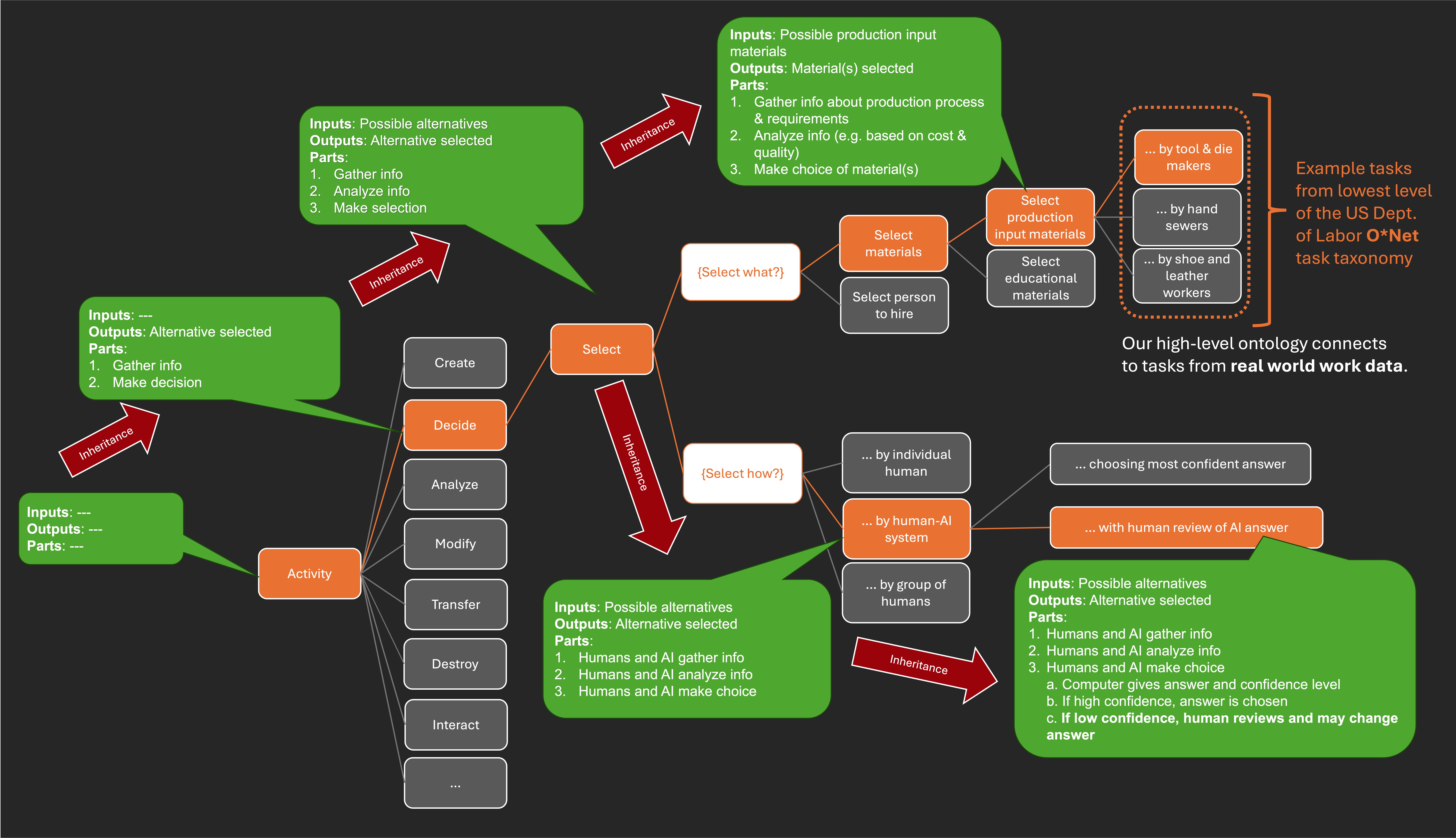
Inheritance
Specializations "inherit" (and may "over-ride") properties from their generalizations:
Parts / processes
Evaluation criteria
Performance prediction models